This policy applies to the following Statutory Officer roles:
• Head of Paid Service (Chief Executive)
• Monitoring Officer
• Section 151 Officer
Additionally, it applies to Non-Statutory Chief Officers (as defined within the Council’s Pay Policy Statement) and their deputies, which means their direct reports. The statement defines "Chief Officers" as those Officers, in addition to the Statutory Officers (named above), who serve as the Management Team for the authority.
For the purposes of this policy, those Officers described above to whom it applies will be referred to as Chief Officers throughout.
The Council seeks to ensure lawful, fair and effective arrangements for dealing with Chief Officers' conduct and disciplinary issues.
This procedure provides a framework for:
• Making those Officers aware of unacceptable conduct
• Dealing with any such issues
This policy is in accordance with the Handbooks and Conditions of Service applicable to the aforementioned posts at the relevant time.
• JNC Conditions of Service for Local Authority Chief Executives (September 2022 version)
• JNC Conditions of Service for Chief Officers (August 2017 version)
• We also refer to The Local Authorities (Standing Orders) (England) (Amendment) Regulations 2015.
The Council has the following framework in place to support the application of these procedures as outlined in the Council’s Constitution (Part 3 - Responsibility of Functions Scheme of Delegated Powers).
• The Human Resources Sub-Committee forming the Panel for the dismissal and disciplinary process for those Officers affected by this policy which is akin to the role of the Investigating and Disciplinary Committee (IDC) as referred to in the JNC Conditions of Service for Local Authority Chief Executives.
• The full Human Resources & Council Tax Committee, undertaking the role of an advisory Independent Panel in accordance with the provisions for the Chief Executive, Chief Financial Officer and the Monitoring Officer (together with the Independent Persons) (Part 3.20), which is akin to the role of the Independent Panel (as referred to in the above, JNC Conditions of Service for Local Authority Chief Executives).
• The Chief Officers’ Employment Appeals Sub-Committee* (“Appeals Sub-Committee”) to consider Employment Appeals under the Council’s Disciplinary Policies and Procedures and the Council’s Appeals Policy relating to the Council’s Statutory Officers and Non-Statutory Chief Officers.
o *The Appeals Sub-Committee must not compromise of any Member who formed part of the Human Resources Sub-Committee when it performed its functions in relation to the dismissal and disciplinary process for the Statutory and Non-Statutory Chief Officers (as defined in Paragraph 3 of Part II of Schedule 1 of the Local Authorities (Standing Orders) (England) Regulations 2001.
o Employment Appeals from Deputy Chief Officers will not be determined by the Sub - Committee as the Council’s Management Team can determine these appeals in line with the existing arrangements.
Members will not be involved in the disciplinary action or dismissal against any Officer below a Deputy Chief Officer. The Council’s Disciplinary Policy, Rules and Procedure, Capability Procedure and related procedures, as adopted from time to time will apply.
Members will not be involved in the dismissal of any officer below Deputy Chief Officer except where such involvement is necessary for any investigation or inquiry into alleged misconduct.
The objectives of this policy are to ensure that:
• The Council meets all relevant legal requirements regarding any disciplinary decisions taken in relation to Chief Officers.
• Chief Officers are treated in a fair and consistent manner.
• The Chief Executive and other relevant managers are supported to ensure Chief Officers meet high standards of conduct.
• The Council, along with our employees, clients, the public, and recipients of our services, are protected from the consequences of misconduct.
At all stages in this procedure, we will ensure that the Chief Officer is:
• Informed of the nature of the issue of concern or case against them.
• Given a chance to explain before any decision is made.
• Given the right to be represented by a work colleague or a recognised trade union representative at any formal investigatory meeting or hearing.
• Given reasonable notice of any formal investigatory meeting or hearing.
• Notified of the outcome of any formal investigatory meeting or hearing in writing.
• Given the right to appeal against formal disciplinary action.
• Confident that we will comply with any legal employment obligations afforded to employees with a disability, in line with the Equality Act in terms of reasonable adjustments.
• Treated with dignity and respect at all times.
• Recognised as being in a situation of potential stress or anxiety and treated accordingly.
• To be supported through a fair and transparent investigation process.
• Confident of the confidentiality of communication, with limited access to others.
• Confident that the process will be carried out promptly and without undue delay.
Chief Officers must:
• Be aware of and conform to the Council’s values, rules, policies and procedures.
• Co-operate with any investigations, and make themselves available to attend any meetings, interviews and hearings.
• Maintain standards of conduct both at work and outside of work.
Misconduct includes:
• The deliberate provision of false or misleading information (for example, on application forms);
• Breaches of our information governance policy;
• Failure to comply with sickness absence procedures and absence management policy;
• Falsification of official accounts or documents (for example, expense claims);
• Incapacity at work, due to the effects of alcohol or non-prescribed drugs;
• Failure to wear or use appropriate equipment or attire made available or necessary for the job. This includes safety equipment unless exempted on the grounds of religion or belief following a risk assessment;
• Unauthorised absence or poor timekeeping;
• Physical violence, indecent behaviour, action or language that is likely to offend. This includes racial, religious or sexual abuse, harassment, bullying or victimisation of others. This includes:
o the prejudice of other employees or members of the public;
• Disruption of others by unruly or disorderly behaviour;
• Discourteous or improper treatment of others;
• Acceptance of bribes or involvement in similar corrupt practice;
• Lack of integrity that may damage public confidence in the Council;
• Unauthorised employment (for example, working in another job during hours when contracted to work for us);
• Working during off-duty hours in a job considered detrimental to our interests;
• Political activity when in a "specified" politically restricted post;
• Engaging in activities or conduct that may adversely affect recovery from illness;
• Conviction of a criminal offence inconsistent with the position the employee holds;
• Use of our time, property or equipment for personal reasons without permission;
• Theft of, misuse of, damage to or neglect of property or equipment;
• Failure to report actual or suspected abuse;
• Disregard for the health and safety of others
This list is illustrative and not exhaustive, a full list can be found in Appendix A. Some examples may be regarded as gross misconduct. This depends upon the circumstances and seriousness of the case. Except in exceptional circumstances, gross misconduct will result in summary dismissal, without notice.
For further details, Chief Officers are directed to the Council’s Officer Code of Conduct.
An employment investigation may run in parallel to a:
• Police
• Audit
• Child protection
• Adult abuse investigation
• Other enforcement bodies
A Chief Officers investigation should not be held up by any such external investigations unless considered prejudicial to those investigations to proceed. The Council may decide on disciplinary action before the outcome of any court hearing.
All employees have the right not to be dismissed or victimised for speaking out. For further details, Chief Officers are directed to the Council’s Whistleblowing Policy.
The Assistant Director - People will decide if an allegation is a staff discipline matter in consultation with:
• The Head of Paid Service
• The Monitoring Officer (or Deputy, where applicable)
The Assistant Director – People will maintain records of any allegations (or the Monitoring Officer where applicable). These records will indicate whether the decision was made to invoke the disciplinary procedure and whether any other action was recommended. Additionally, the records will detail the advice provided by the Assistant Director – People and the Monitoring Officer, including instances where the procedure has not been invoked but another action is recommended.
This is to ensure that the appropriate alternative action is taken. For example, complaints about a particular service are dealt with through the Council’s corporate complaints procedure.
A grievance directed against a Chief Officer is first dealt with through the Council’s Grievance Procedure.
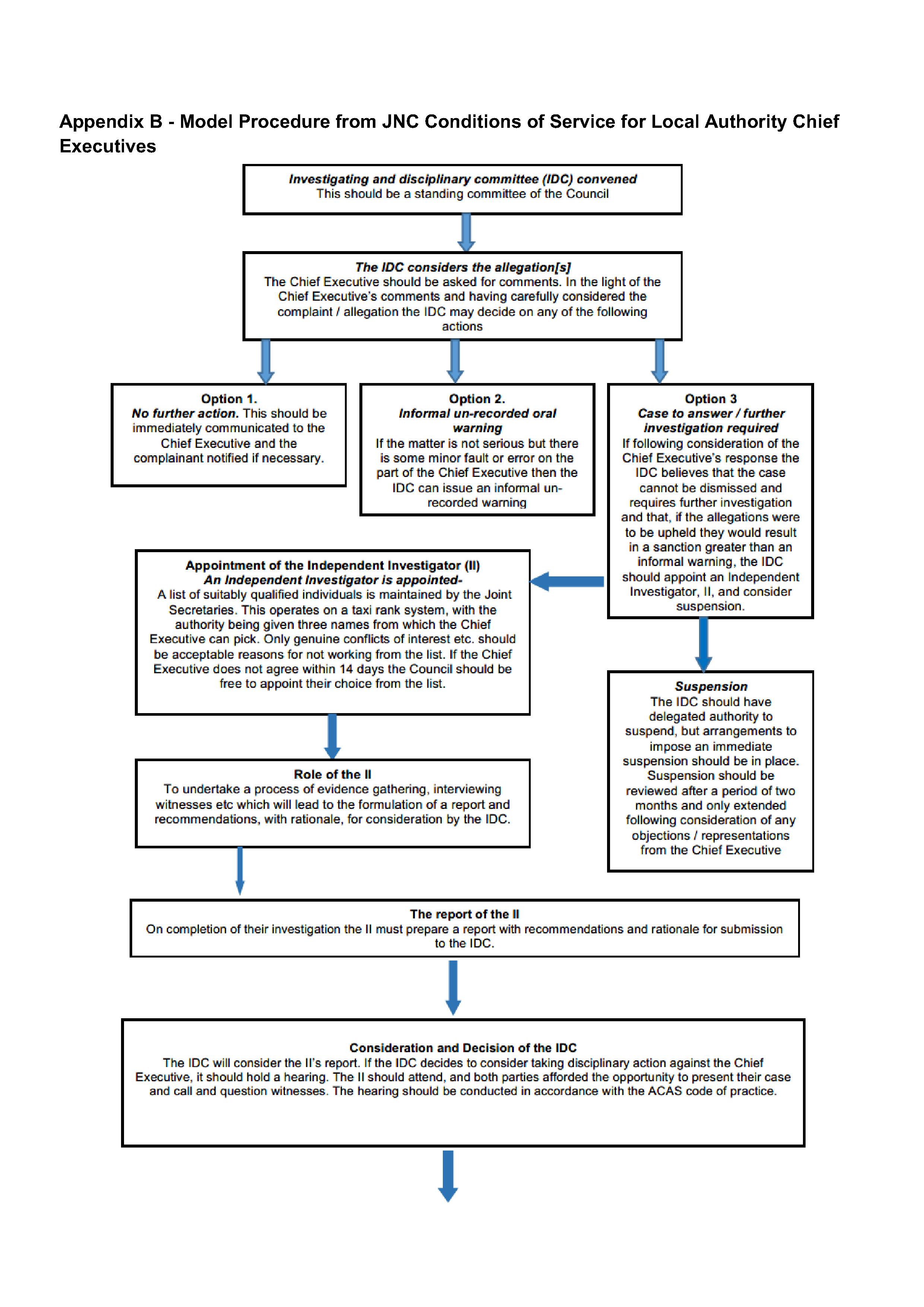
The Council may suspend the Chief Officer from work or temporarily redeploy them to work elsewhere. This may happen in cases where the allegations are serious or to facilitate an unhindered investigation.
Such actions do not constitute disciplinary action or imply guilt on the part of the employee. We give suspended employees support and appropriate guidance. The suspension, or temporary redeployment, is reviewed after 2 months.
The Human Resources Sub-Committee (known hereafter, for the purposes of this procedure as the Investigating and Disciplinary Committee (IDC)) will consider whether to suspend the Chief Officer with advice from the Assistant Director - People or the Monitoring Officer, as appropriate. This may be necessary if there is enough evidence to suggest that:
• The Chief Officer may be guilty of gross misconduct.
• The Chief Officer's continuing presence at work compromises the investigation.
• The Chief Officer's continuing presence impairs the Council’s functions.
Gross misconduct is generally defined as misconduct serious enough to:
• Destroy the employment contract,
• Make any further working relationship and trust impossible.
Suspension should be reviewed after the specified period above to ensure it remains justified and only extended following consideration of any objections / representations from the Chief Officer.
Where an allegation is made relating to the conduct of a Chief Officer, or there is some other substantial issue that requires investigation, the matter will be dealt with by the Investigating and Disciplinary Committee (IDC). The Assistant Director - People will support the IDC throughout the process, along with the Monitoring Officer, as appropriate.
The IDC may dismiss the allegation without a formal investigation or, in some cases, with minimal investigation. However, this procedure aims to address situations where the matter is not so easily dismissed.
If the allegation is deemed to not be serious enough to warrant a formal investigation but there is some minor fault or error on the part of the Chief Officer, the IDC can issue an informal unrecorded warning.
If the IDC determines that the matter warrants further investigation, the Assistant Director - People will inform the Chief Officer in writing of the allegations or other issues and provide them with any evidence that they are to consider. The Chief Officer will have the right to be accompanied by a representative during any formal meetings.
Upon receipt of all of the evidence collected, with advice from the Assistant Director – People, and, where appropriate from the Monitoring Officer, the IDC will decide whether:
• The issue requires no further formal action under this procedure, or To commission an investigation. If appropriate, they may appoint an investigator from outside of the Council.
The Assistant Director – People, on behalf of the IDC, will inform the Chief Officer of the decision in writing, including details of the Independent Investigator, if applicable.
The Head of Paid Service will also be informed that an investigator has been appointed.
The Chair of the IDC, in consultation with the Assistant Director – People, and the Monitoring Officer, if appropriate will:
• Determine the terms of appointment of the investigator;
• Agree to any remuneration, if appropriate;
• Provide facilities;
• Provide all available information regarding allegations or other issues under investigation.
The investigator is entitled to interview witnesses and conduct enquiries. This may include examining:
• Internet
• Other IT systems
• The accounts of the Chief Officer.
The Chief Officer must:
• Fully co-operate will the investigator
• Make themselves available for interviews and meetings
• Provide any relevant documentation or information to the investigator.
In order to allow the Chief Officer to prepare their responses to the terms agreed by the investigator, the Council will endeavour to provide reasonable facilities and access:
• To the Council's premises
• To the Council’s systems
• To personal files and diaries.
The amount of time spent on the investigation will depend on the case. The investigator may delegate some of the investigation work to an assistant. The Chair of the IDC must agree to this and ensure the Chief Officer is informed.
The investigator will prepare an investigation report stating, in their opinion:
• Whether and to what extent, the evidence supports any allegation of misconduct, or
• The evidence supports a need for action for some other substantial reason.
After the investigation, the Chair of the IDC, in consultation with the Assistant Director – People, and the Monitoring Officer, as appropriate, will decide whether to refer the case to be formally heard by the IDC.
The Assistant Director – People will write to the Chief Officer providing at least 10 working days' written notice of the date of the IDC Hearing (known hereafter as the Disciplinary Hearing). The notice will include:
1. The time and place of the Disciplinary Hearing;
2. Who will be in attendance at the hearing, including the details of the Panel Members;
3. Confirmation that the Chief Officer may be accompanied by:
o a work colleague
o recognised trade union Officer
o or recognised trade union Officer representative;
4. A copy of this procedure.
Within two working days of receipt of notice of the Disciplinary Hearing, the Chief Officer will confirm their agreement to the date for the hearing. If not, they must propose a postponement for no longer than 10 working days setting out the reasons for the request.
An Independent Advisor will advise the Disciplinary Hearing Panel at the hearing. This may be the Assistant Director – People, the Monitoring Officer, or a representative from legal services.
The Assistant Director – People will arrange for a written record of the hearing. This may be an audio recording and transcribed into a paper record.
The procedure for the Disciplinary Hearing is:
1. The Chair of the Disciplinary Hearing will explain the purpose of the hearing and procedure
2. The appointed investigator will present the report to all members of the hearing and invite witnesses to support the case.
3. The Chief Officer and Disciplinary Hearing Panel may ask questions of the investigator and any witnesses.
4. The Chief Officer has the opportunity to state their case and invite witnesses to support their case.
5. The Disciplinary Hearing Panel and investigator may ask questions of the Chief Officer and any witnesses.
6. Both sides will sum-up their presentations, starting with the investigator.
When the Disciplinary Hearing Panel has heard all of the evidence submitted, they will adjourn to consider what, if any, further action to take.
All others present at the hearing will withdraw while the Disciplinary Hearing Panel consider their decision. The Independent Adviser and, if appropriate, the Monitoring Officer will advise them.
A letter from the Disciplinary Hearing Panel will be sent to the Chief Officer within 3 working days, outlining its decision, and the rationale behind the decision taken.
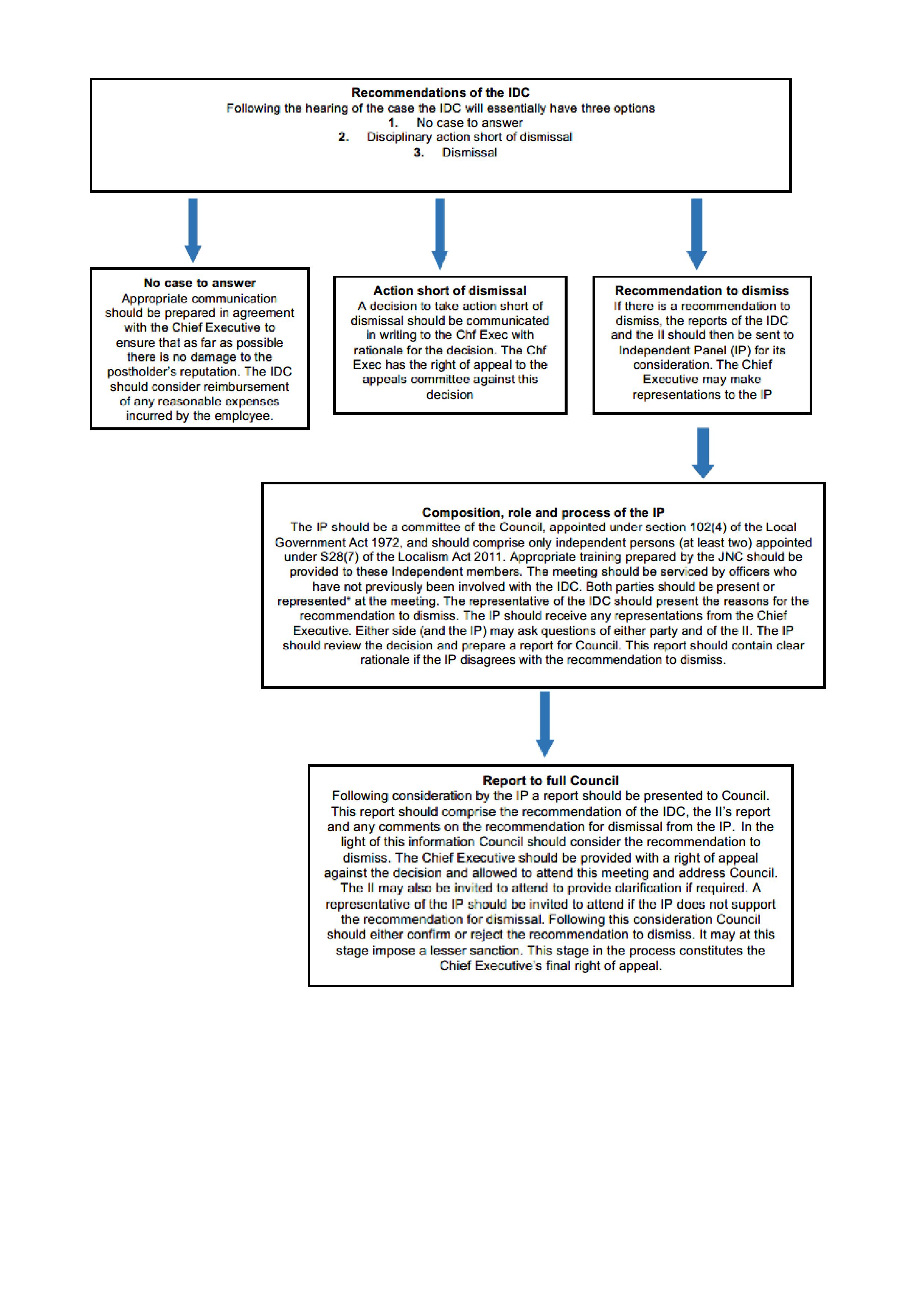
The policy allows for the following hearing outcomes:
Where the Panel considers there is no case to answer.
This is where the Chief Officer's:
• Conduct has fallen below acceptable standards;
• The offence is sufficiently serious to justify an immediate formal sanction.
The warning is live for disciplinary purposes for up to 9 months, as determined by the Panel at the Disciplinary Hearing.
This is where the Chief Officer's:
• Conduct continues to be significantly below acceptable standards, and previous written warnings have not resulted in sufficient improvement;
• Offence is so severe that a final warning is appropriate as a first formal warning, or
• Dismissal would typically be appropriate, but significant mitigation is accepted.
The warning is live for disciplinary purposes for up to 18 months, as determined by the Panel at the Disciplinary Hearing.
All warnings are confirmed in writing and will include:
• A clear statement of the unsatisfactory conduct or behaviour.
• The level of the warning.
• The length of time it will remain live for disciplinary purposes.
• The required level of improvement (in measurable terms).
• The consequences of no improvement in conduct or behaviour.
• The right to appeal.
Dismissal will occur where there has been:
• Gross misconduct;
• A final written warning issued, and further misconduct or unsatisfactory conduct has taken place.
Unless the Chief Officer is dismissed for gross misconduct, they will receive the appropriate period of contractual notice.
Except in exceptional circumstances, actions of gross misconduct will justify dismissal without notice.
Where the Disciplinary Hearing Panel proposes dismissal, it will inform the Monitoring Officer (or Deputy Monitoring Officer as appropriate).
The Monitoring Officer (or Deputy as appropriate) will notify every member of the Executive of:
• The Disciplinary Hearing Panel’s proposal to dismiss the Chief Officer;
• Any other particulars relevant to the dismissal;
• The period by which any objection to the dismissal proposal should be submitted (within five working days).
At the end of this period, the Monitoring Officer (or Deputy as appropriate) will either:
• Inform the Disciplinary Hearing Panel that members of the executive have received no objections, or
• Notify the Disciplinary Hearing Panel that an objection has been received and provide details.
The Disciplinary Hearing Panel will consider any objections and satisfy itself as to whether any of the objections are both material and well-grounded. Where necessary, the Panel may reconvene to deliberate over any objections submitted. If the objections are considered to be valid, then the Disciplinary Hearing Panel will act accordingly, which may include overturning the decision to dismiss or submitting their recommendation to dismiss, along with the details of any submitted valid objections for consideration by the Independent Panel.
If there are no material or well-founded objections to the proposal to dismiss, the Chair of the Disciplinary Hearing Panel will inform the Monitoring Officer (or Deputy as appropriate). The Monitoring Officer will then make arrangements for the case to be heard by the Relevant Independent Person’s Panel.
Where the proposal is dismissal, the Monitoring Officer will make arrangements for the Relevant Independent Person's Panel to review the case and recommendations.
The Panel must include at least two Independent Persons. They must be defined in the Local Authorities (Standing Orders) (England) (Amendment) Regulations 2015 as persons appointed under Section 28(7) of the Localism Act 2011.
The Panel will receive:
• The proposal to dismiss from the chair of the IDC
• The report from the Independent Investigator
• Any oral and written representations made by the Chief Officer.
We may invite an Independent Investigator to attend to provide clarification if required.
The panel is at liberty to ask questions of either party.
The panel will then forward any advice, views or recommendations to the Council. If the panel recommends an action other than that we should approve the dismissal, it must give clear reasons.
The dismissal of statutory officers in local government must be approved by the Full Council.
In the case of the three Statutory Officer(s) named in this procedure, following consideration by the Independent Panel (IP), a report should be presented to the Council. This report should include the recommendation of the IDC, the Independent Investigator’s (II) report, and any comments on the recommendation for dismissal from the IP. Based on this information, the Council should consider the recommendation to dismiss.
The Statutory Officer(s) should be provided with a right of appeal against the decision and allowed to attend the meeting to address the Council. The Independent Investigator may also be invited to attend to provide clarification if required. If the IP does not support the recommendation for dismissal, a representative of the IP should also be invited to attend.
Following this consideration, the Council should either confirm or reject the recommendation to dismiss. At this stage, the Council may impose a lesser sanction if deemed appropriate. This stage in the process constitutes the Statutory Officer(s)' final right of appeal.
The Officer may appeal against a disciplinary sanction. The Officer must confirm in writing within 10 working days of receipt of written confirmation of the decision. Any appeal is made to the Assistant Director - People and is heard by the Chief Officers’ Employment Appeals Sub-Committee.
Receipt of a letter is deemed to have taken place two days after posting if sent by first class post.
The Officer must outline one or more of the following reasons upon which they seek to appeal and provide evidence. The reasons for appeal may include:
• There was a defect in the procedure;
• Not all evidence was considered;
• The dismissal sanction was too severe;
• New evidence has come to light since the last hearing.
The Council may consider new evidence in the Appeal Hearing. The Officer must include it in the documents submitted prior to the hearing. The Chief Officers’ Employment Appeals Sub-Committee may agree to admit late new evidence.
Where new evidence is to be submitted, the employee should state clearly:
• What the evidence is;
• Why it is believed that it would alter the original decision;
• Why it was not included at the previous hearing.
If the appeal relates to a defect in the original hearing process or procedure, the Assistant Director - People may advise that a re-hearing is held in place of the Appeal Hearing. If this is the case, the meeting will follow the original hearing procedure. They will invite all parties and witnesses. The panel and possible outcomes will be consistent with the Appeal Hearing Procedure.
The Council will arrange for an Independent Adviser to advise the Chief Officers’ Employment Appeals Sub-Committee at the hearing. This may be the Assistant Director – People, the Monitoring Officer, or a representative from legal services.
The Monitoring Officer (or Deputy as appropriate) will arrange for a written record of the hearing. This may be an audio recording and transcribed into a paper record.
The procedure for the Chief Officers’ Employment Appeals Sub-Committee is:
1. The chair of the Chief Officers’ Employment Appeals Sub-Committee will explain the purpose of the hearing and procedure.
2. The Officer presents their case based on the grounds specified when submitting the appeal.
3. The Chair of the IDC and the designated Independent Person may ask the Officer questions.
4. The Chief Officers’ Employment Appeals Sub-Committee may ask the Officer questions.
5. The Chair of the IDC or the Investigator presents the management position in response to the Officer's grounds of appeal.
6. Both sides will sum-up their presentations. The employer will be invited by the panel to make a final statement, followed by the employee who should always have the last word. No new evidence may be introduced at this point by either party.
When the Chief Officers’ Employment Appeals Sub-Committee has heard all of the evidence, they will adjourn to consider whether to uphold or dismiss the appeal. The Independent Adviser and Monitoring Officer (or Deputy as appropriate) may advise them.
All others present at the hearing will withdraw.
A letter will be issued within 3 working days, outlining the decision of the Chief Officers’ Employment Appeals Sub-Committee.
We have a duty to refer information to the Disclosure and Barring Service (DBS) where we:
• Have removed an individual from working or volunteering
• Have concerns about an individual's contact with children or vulnerable adults.
We may refer to other professional bodies the circumstances of a case (for example, the teaching agency or health care professions council).
Legal and HR Advisor
In the case where the Council’s Monitoring Officer or Assistant Director – People is subject to a disciplinary investigation; the IDC will seek external legal or HR advice and the Monitoring Officer’s or Assistant Director – People’s role referenced within this policy will be replaced by that external advisor.
Please note these examples are neither exclusive nor exhaustive.
Minor or Serious Misconduct (depending upon the circumstances or persistency)
• Poor timekeeping;
• Unjustifiable absence from work failure to comply with procedures covering the notification of sickness absence;
• Where an employee without reasonable and sufficient cause, disobeys, omits or neglects to carry out reasonable orders whether given orally or in writing;
• Failure to disclose involvement in a criminal or civil case (including County Court judgements);
• Poor standards of personal hygiene;
• Acts of minor insubordination;
• Neglect of duty;
• Non-compliance with the Corporate Information Security Policy (including excessive personal use of any means of electronic communication);
• Neglect of health and safety requirements at work;
• Non-compliance with financial regulations or standing orders;
• Smoking/vaping on Council premises;
• Use of paid working time for purposes unrelated to the job;
• Failure to follow Council procedures, including financial procedures and Human Resource procedures;
• Failure to follow reasonable management instructions;
• Non-compliance with the No Smoking Policy.
• Bringing the Council’s reputation into disrepute including through the use of social media.
Gross Misconduct
• General misconduct (e.g., insolent, aggressive, drug related or drunken behaviour, bullying, harassment, excessive foul language, rudeness, explicit sexual, racial or other discriminatory behaviour);
• Deliberate failure to disclose any personal interest which may be incompatible with the satisfactory discharge of the duties and responsibilities of the job;
• Behaviour of a serious or criminal nature outside the employment of the Council, the nature of which, in the opinion of the IDC/Chief Executive/Corporate Director, makes continued employment impossible;
• Committal to prison for an offence the nature of which, or the length of sentence imposed, in the opinion of the IDC/Chief Executive/Corporate Director, makes continued employment impossible;
• Serious professional or similar negligence, misconduct, omission or, in certain situations, failure in performance and/or behaviour to a reasonable and acceptable standard;
• Theft or misappropriation of cash, data or property belonging to Tendring District Council, fellow employees or persons receiving a service from Tendring District Council;
• Deliberate and wrongful disclosure of security passwords or illegal actions in connection with the e-mail, Intranet or internet;
• Serious failure to disclose interest in Council contracts;
• Misuse of employee’s office for personal gain;
• Abuse against children or adults at risk, or any other breach as outlined in the Council’s Safeguarding Policy and Procedures.
• Fraudulent falsification of timesheets, bonus sheets, financial claims for reimbursement, flexible working hours time or similar documents to which the employee is not entitled;
• Dealing or wrongful possession of illegal drugs;
• Threatened or actual physical assault;
• Fighting or riotous behaviour and similar actions;
• Breaches of confidence and trust so serious as to destroy the employment contract and make any further working relationship and trust impossible;
• Serious breaches of safety regulations in contravention of the Health and Safety at Work Act and/or relevant codes of practice and safe methods of work;
• Malicious damage to Council property;
• False statements made in applications for employment designed to ensure appointment;
• The contravention of the Asylum and Immigration Act, e.g. by producing fraudulent documentation;
• Deliberate failure to disclose unspent criminal convictions or, in respect of employment, exempt under the terms of the Rehabilitation of Offenders Acts, failure to disclose any conviction (including caution or bind over) at any time before or during employment with Tendring District Council;
• Aiding and/or abetting the commission of an act of gross misconduct.16